Edge AI Human Activity Recognition on ESP32-S3
Sixteen human activities, recognised from raw motion data — trained on a GPU, then squeezed down until the whole thing runs on a microcontroller reading its own sensors in real time.
A model on a laptop is not a product
Human activity recognition from inertial sensors is a solved-looking problem right up until you have to run it somewhere real. On a microcontroller there is no Python, no floating-point luxury, a few hundred kilobytes of usable memory, and a recurrent layer that the on-device runtime flatly refuses to execute.
This project takes the problem the whole distance: sixteen activities classified from dual-IMU multivariate time series — accelerometer and gyroscope — trained, optimised, converted, quantised and finally deployed as C++ firmware that classifies live sensor data on an ESP32-S3.
Getting the split right, first
Time-series activity data punishes careless splitting. Slice windows at random and neighbouring, near-identical windows land on both sides of the train/test boundary — the model scores brilliantly and has learned nothing transferable.
So the windowing and splitting scheme came before the modelling: a leakage-free, segment-based design where windows are cut within contiguous recording segments and whole segments — never individual windows — are assigned to a split. Every accuracy figure below rests on that decision.
Segment-based splitting — whole segments move together, so no window is ever seen twice
Three architectures, searched not guessed
- Benchmarked CNN, CNN-LSTM and CNN-GRU against the same splits — convolution alone versus convolution plus recurrence, on identical ground.
- Hyperparameters chosen by Optuna search rather than intuition, so the comparison between architectures is a comparison of architectures and not of how much time each one got tuned.
- Trained on GPU with CUDA and automatic mixed precision, reaching up to 85.6% accuracy.
The recurrent layer that wouldn't convert
Going from PyTorch to TFLite Micro means passing through ONNX and TensorFlow, and recurrent layers do not survive that trip cleanly: they arrive as dynamic WHILE loop operators, which the microcontroller runtime does not implement. The usual response is to drop the recurrent models and ship the CNN.
Instead I wrote custom unrolled-RNN export wrappers that expand the recurrence into a fixed sequence of operations at export time, removing the unsupported WHILE ops entirely. The unrolled graphs match the original models to within 1e-4 output deviation — close enough that the conversion is not a source of error worth reasoning about.
Every model was then quantised to INT8 for TFLite Micro.
Accuracy is one axis of three
On a microcontroller the most accurate model is frequently the wrong one. Selection used a composite score across accuracy, latency and model size — the deployment candidate won with 5× fewer parameters than the largest contender.
Firmware, not a demo script
The device side is C++ firmware on an ESP32-S3 running all six quantised models against live IMU data — not a single frozen artefact, but a switchable set you can compare on the bench.
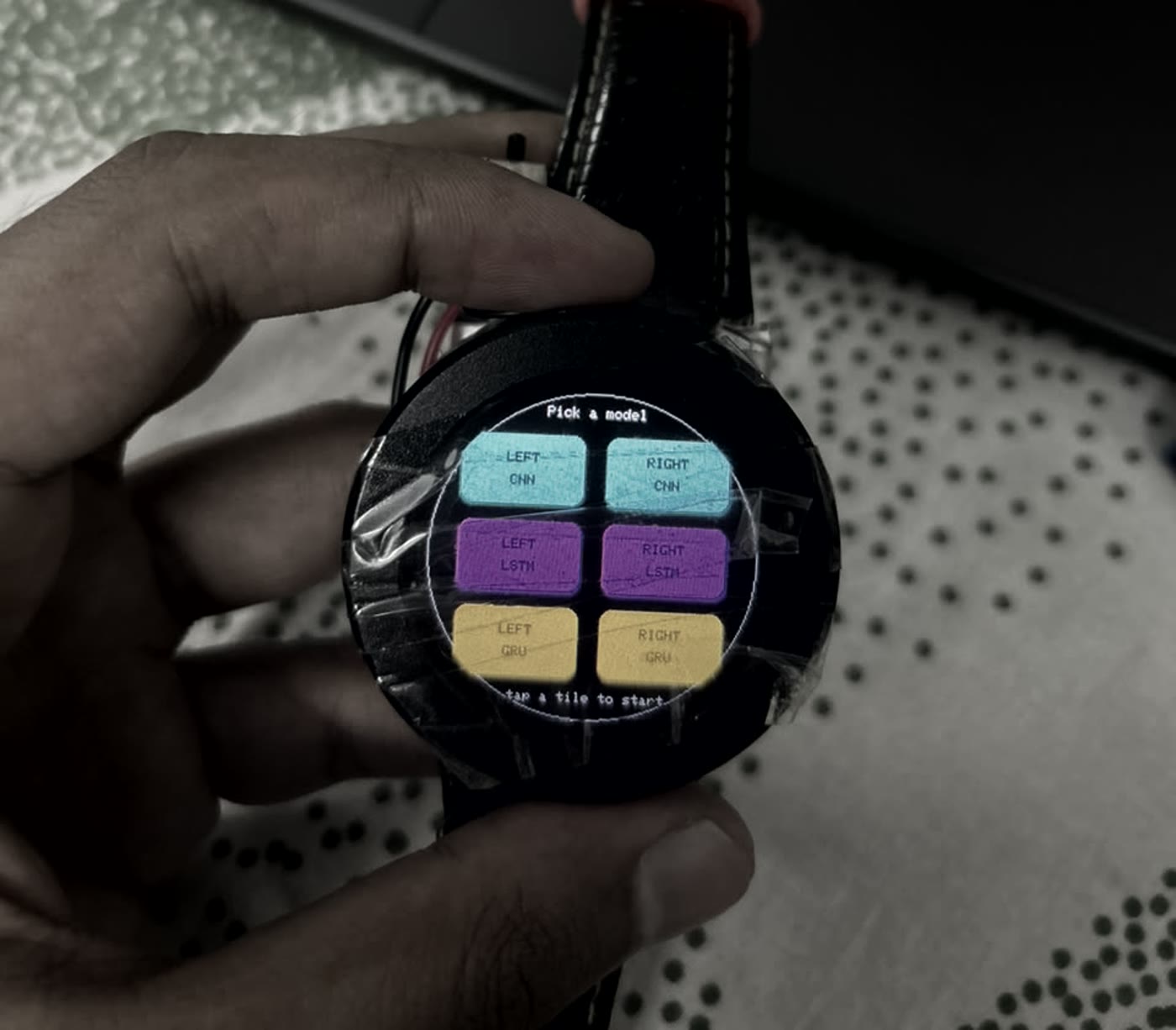
- A touchscreen model-picker UI — swap the active model on the device, no reflash.
- Bit-exact StandardScaler preprocessing reimplemented in C++, so the features the firmware computes are the features the model was trained on. This is where silent accuracy loss usually hides.
- PSRAM tensor arenas, because six models will not share the ESP32-S3's internal RAM.
- On-device latency and memory benchmarking, so the numbers used to pick a model are measured on the target rather than estimated from the host.
- A custom 16 MB dual-slot OTA partition table and wireless firmware updates — the device can be re-flashed in place and rolled back if a build misbehaves.
On the wrist
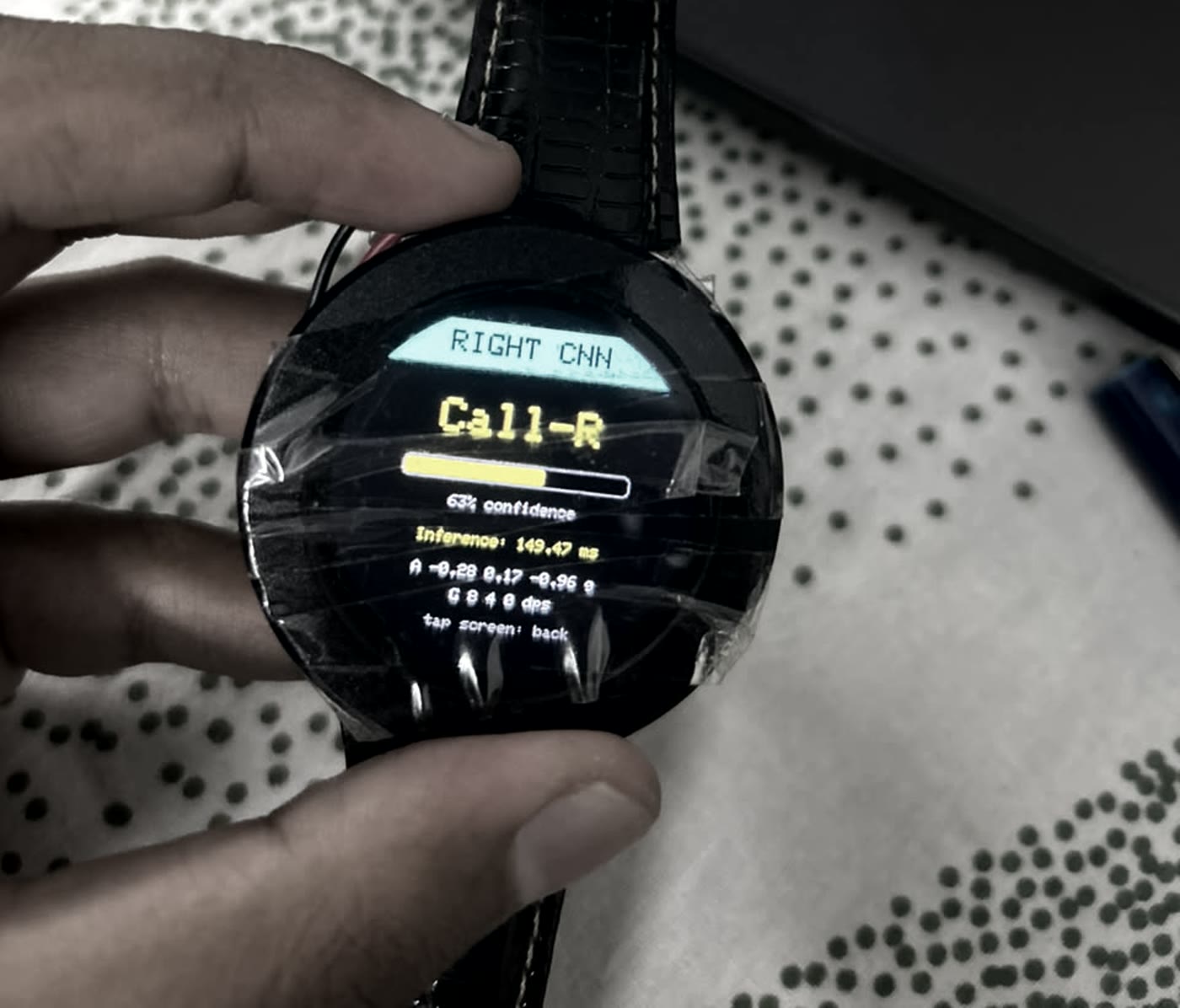
The firmware runs on a round touchscreen ESP32-S3 in a watch body. Pick a model from the grid, and it classifies live IMU data with the prediction, confidence and the measured inference time on screen.
Training
- PyTorch
- CUDA / AMP
- Optuna
Conversion
- ONNX
- TensorFlow
- TFLite Micro
- INT8
Device
- ESP32-S3
- C++
- PSRAM
- OTA
Sensing
- Dual IMU
- Accelerometer
- Gyroscope